
AHMED NABIYEV
Cluster Contemporary Jewellery
”AMALGAM”
Ahmad Nabiyev is an Azerbaijani multidisciplinary artist, designer, and founder of ANIC8NIC. His practice explores cultural memory, identity, and the transformation of physical heritage into digital forms through digital fashion, jewellery, 3D design, moving image, and AI-assisted technologies.
Drawing on Azerbaijani ornamental and material traditions, Nabiyev creates hybrid physical-digital works that question how cultural identity evolves within technological environments. His work has been presented at Milan Digital Fashion Week and featured in Vogue Italia, Vogue Polska, Cosmopolitan, and Harper’s Bazaar. In 2021, he won the DRESSX Gen-F competition with Silicone Road.


“I work with what happens to identity when it moves between worlds.
My practice exists between the physical and the digital, personal memory and collective heritage, tradition and technological futures. Through digital fashion, 3D, jewellery, textiles, moving image, and AI, I create objects and visual environments in which cultural forms are given the possibility to exist differently.
Coming from Azerbaijan, a place shaped by the constant movement of people, images, materials, and ideas, I understand heritage not as something fixed or completed. I see it as a living system that changes together with the person who inherits it.
I work with ornament, silhouette, textile, architecture, and other cultural forms not to reproduce them literally, but to ask what remains when they are transformed.
When a physical object becomes digital, it loses part of its material presence while gaining new possibilities. It can exist across multiple spaces, take on new forms, and acquire another identity. This transition — between an object and its image, memory and its reconstruction, the human and its digital reflection — is one of the central territories of my practice.
Technology, for me, is a medium rather than a subject in itself. I use digital tools, 3D, and AI to expand the possibilities of artistic language and to explore new ways of speaking about memory, belonging, and identity.
My work is not about preserving the past unchanged. It is about translating it into the future.
Because cultural memory remains alive only when it is allowed to change.”
AFTER THE VEIL
Project Manifesto
After the Veil is a digital fashion film and visual exploration at the intersection of Azerbaijani cultural heritage, contemporary art, digital fashion, 3D design, and artificial intelligence.
The project presents a journey through a surreal landscape where familiar cultural symbols gradually transform into digital artifacts. The past is not reconstructed literally; instead, it is translated into the language of the future.
At the center of the narrative is the heroine’s journey toward her own vision. She moves through the landscape, discovers artifacts, puts them on, and gradually transforms her perception of the world around her. The glasses, claw glove, jewellery, and red veil become more than costume elements — they become instruments of transformation.
After the Veil is the moment when a person moves beyond inherited perceptions of identity and begins to create a path of their own.
HERITAGE AS A DIGITAL ARTIFACT
The project is built around 3D jewellery and wearable objects visually connected to traditions of Azerbaijani jewellery art of the 19th century.
However, this is not a historical reconstruction.
Traditional forms become source material for a new visual language: metal transforms into futuristic surfaces, ornament becomes structure, and jewellery becomes an interface between the human body and digital space.
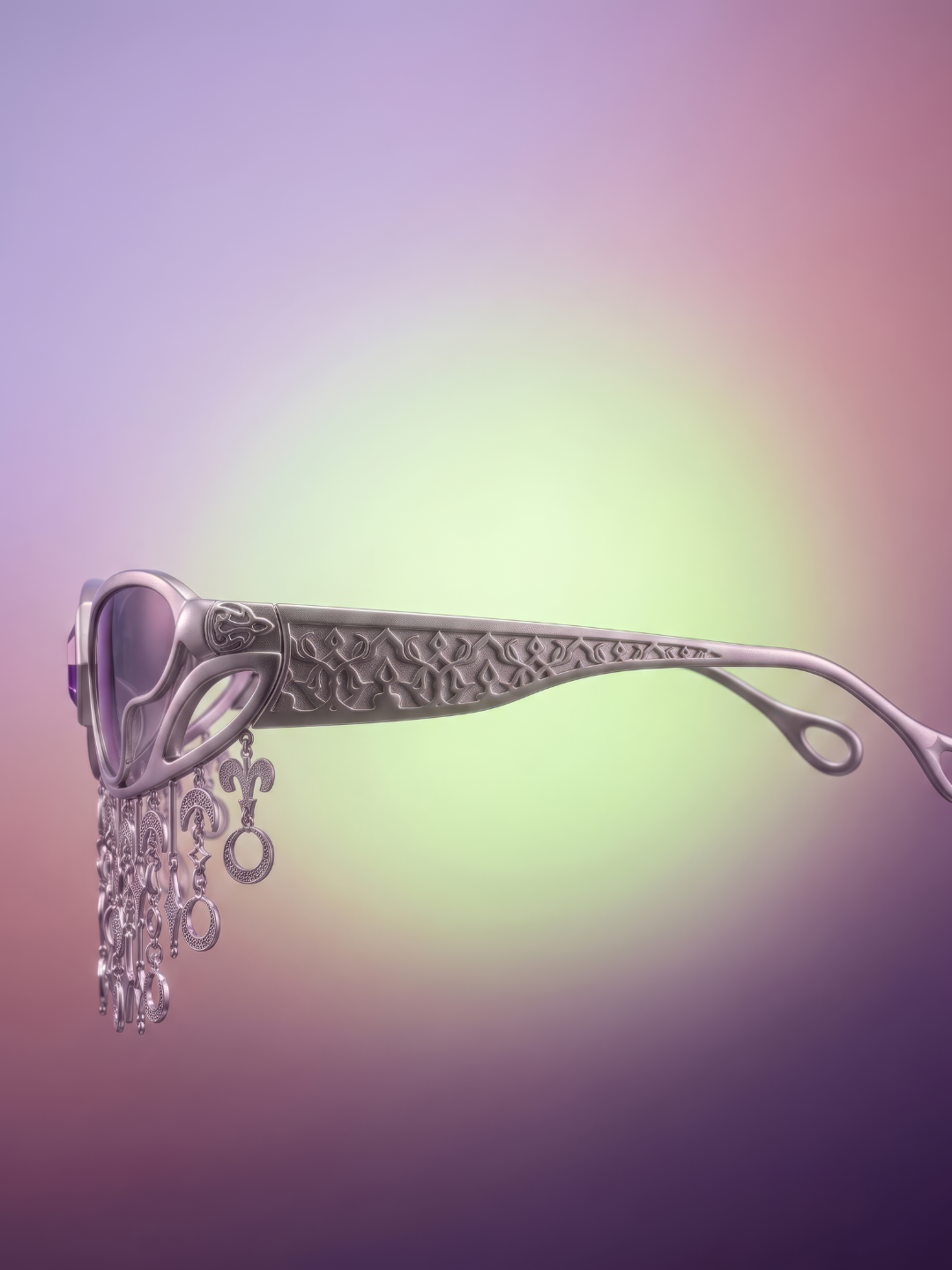
The glasses represent a new form of vision — the ability to see what was previously hidden.
The claw glove becomes an extension of the hand, symbolising action, control, and independent choice.
The artifacts do not simply adorn the heroine — they transform her relationship with the space around her.
THE SYMBOLIC LANGUAGE
Five central images form the visual and conceptual system of the project.
THE RED VEIL - TRANSFORMATION
The red veil is one of the central visual elements of the project.
It references Azerbaijani wedding and ritual culture, particularly the visual language of Xınayaxdı.
In After the Veil, this cultural reference receives a contemporary artistic interpretation.
The veil gradually separates from the heroine, becoming an independent moving object that leads her through the landscape. At the end of the journey, it burns — not as a destruction of heritage, but as a release from its fixed form.
The veil does not disappear.
It transforms.
THE QUINCE - MEMORY / LAND
The quince connects the digital world of the project to physical land and memory.
It is a familiar, tangible object that appears within the surreal landscape as a fragment of cultural memory. Its presence suggests that even in the most futuristic environment, cultural identity continues to exist through material things — food, land, colour, texture, and everyday rituals.
The quince becomes a point of contact between the real and the virtual.
THE HORSE - MOVEMENT / FREEDOM
The white horse accompanies the heroine at the beginning of her journey.
It represents movement, physical strength, and freedom, while also functioning as a guide between different stages of the narrative.
Gradually, the heroine leaves the horse behind and continues on foot.
This transition is essential:
At first, she follows the movement. Then, movement becomes her own choice.
The horse remains behind while the heroine continues forward independently.
THE THREE MOONS - CYCLE / VISION
The three moons, arranged in a triangular formation, create the project's own celestial system.
Their different phases become a visual code for transformation, cycles, and transitions between states.
They are not intended as a literal religious or historical symbol.
Instead, they form an original sign created within the project, representing three stages of the journey:
DISCOVERY → TRANSFORMATION → ARRIVAL
Or:
LEVEL 01 → LEVEL 02 → LEVEL 03
ATESHGAH — FIRE / TRANSFORMATION
The final destination of the journey is a futuristic interpretation of Ateshgah, the Fire Temple in Surakhani, Baku.
In the project, the historical architecture is reimagined through chrome surfaces, 3D modelling, and speculative architecture.
The temple becomes a space of final transition.
Here, the red veil that has accompanied the heroine throughout the journey encounters fire.
Fire becomes not an act of destruction, but an act of transformation.
What was once a physical object becomes a trace.
What was once cultural memory becomes a new visual language.
FROM HERITAGE TO FUTURE
After the Veil does not seek to present tradition as a museum object.
Instead, the project asks:
What happens to cultural heritage when we stop simply preserving it and begin creating the future from it?
Here, ornament becomes an interface.
Jewellery becomes technology.
Clothing becomes a digital shell.
The landscape becomes a game-like environment.
And cultural memory becomes material for new imagination.
The project brings together craft, fashion, 3D, AI, moving image, and speculative world-building, creating a hybrid visual system in which the physical and digital no longer exist as separate realities.
After the Veil is not a story about the past.
It is a story about what we can create from the past.
THE FUTURE IS NOT BEYOND HER HERITAGE.
THE FUTURE IS WHAT SHE BUILDS FROM IT.
This translation preserves the conceptual structure and terminology of the project document you uploaded.